On this page
Black Friday email marketing works better when the decisions happen before the inbox gets busy. A clear offer sent to the right subscribers is easier to understand than a series of increasingly urgent messages to everyone on your list. Start by deciding what you can deliver, who will find it useful, and when the offer really ends.
This guide gives a small team a practical campaign structure. The timing and examples are starting points, not performance benchmarks. Adapt them to your usual sending frequency, customer buying cycle and stock. You do not need a complicated automation to run a useful seasonal campaign; you need a plan that somebody can review before each send.
Start with an offer you can explain in one sentence
Write the offer as if a customer asked you at the checkout: what do I get, what does it cost, and what conditions apply? A discount on selected products, a useful bundle or early access can all work. The important part is that the email and landing page describe the same thing, with the same exclusions and end time.
Check the economics before choosing the headline. A larger discount can increase orders while leaving less money after product costs, shipping, returns and payment fees. Pick a commercial outcome such as profitable first purchases or repeat purchases from existing customers. That outcome should decide the audience and offer, rather than a target open rate deciding the campaign.
- Name the eligible products. Avoid making readers discover exclusions after they click.
- Specify the deadline and timezone. Use a real closing time that your store will honor.
- Check stock and fulfillment. Do not promise delivery dates the team cannot support.
- Choose one primary action. Send readers to the collection, bundle or product described in the message.
Choose audiences before choosing subject lines
Begin with subscribers who already expect marketing from you. A seasonal promotion is a poor moment to revive an old import or suddenly increase volume to people who have not responded for months. Keep unsubscribe, bounce and complaint exclusions in place across every audience. Do not let a manually assembled holiday list bypass them.
| Audience | Useful message | Check before sending |
|---|---|---|
| Engaged subscribers who have not purchased | Explain the offer and remove buying uncertainty | Does the landing page explain shipping and returns? |
| Existing customers | Suggest a relevant repeat purchase or complementary product | Is the suggestion based on data you actually have? |
| Subscribers who requested early access | Deliver the access you promised | Does the link work before the public launch? |
| People who already bought the promoted item | Exclude from repeated purchase reminders | Has the latest purchase data arrived? |
Use simple segments you can explain. If the only reliable information is signup source and recent clicks, start there. A precise audience built from incomplete purchase history can be less useful than a broad, well-understood group. For a general method, see the email segmentation guide.
Give each email a separate job
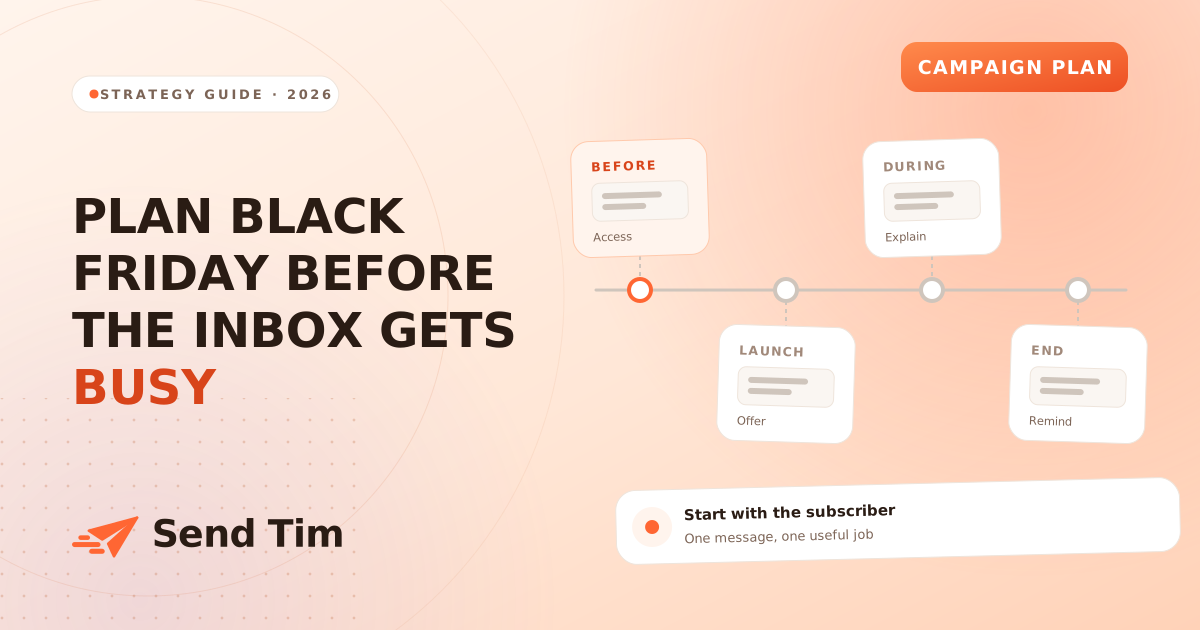
The sequence below is an editorial plan, not a requirement to send four messages. If your readers normally hear from you once a month, compress the plan. If you send regularly, a short seasonal increase may make sense, but every additional email should answer a different customer question. Write the reason for each send beside its draft.
| Stage | Purpose | Example angle |
|---|---|---|
| Before launch | Set expectations | What is included and how to get early access |
| Launch | Make the offer available | The collection is open, with terms beside the button |
| During the offer | Help people decide | Sizing, compatibility, delivery or a useful comparison |
| Before the real deadline | Remind interested subscribers | The offer ends at the stated time tonight |
Do not schedule the final reminder and forget about it. Review current stock, support issues and customer exclusions first. If the offer has changed, update both the message and destination. If purchase data is delayed, consider a smaller reminder audience or copy that acknowledges the reader may already have ordered. Never claim that a purchase failed simply because your campaign has no conversion record.
Write specific subject lines and useful email copy
A subject line should make a promise the message immediately keeps. Pair it with preview text that adds information instead of repeating the same words. Use the body to explain the offer, show the relevant products and answer one likely objection. Keep important terms as readable text so they remain available when images do not load.
| Message | Subject line example | Preview text example |
|---|---|---|
| Early access | Your early access opens tomorrow | A first look at the selected winter bundles. |
| Launch | The winter bundle offer is now live | See included products and the closing time inside. |
| Decision support | Which bundle fits your setup? | A short comparison before you choose. |
| Final reminder | The bundle offer ends at 8 pm EET | One last reminder before the stated deadline. |
These are example lines, so replace every product, deadline and access claim with something true for your store. Avoid a misleading reply prefix or a countdown that resets. See email subject lines for more ways to make a promise concrete, and email design for a mobile-friendly layout.
Run a pre-send check on the complete journey
- Audience: inspect a sample of recipients and confirm exclusions still apply. Recheck counts after the final import.
- Offer: test the discount with eligible and excluded products, and verify the amount shown at checkout.
- Links: open every button and text link from a test email. Check tracking parameters and the destination on a phone.
- Rendering: review readable text, image descriptions, contrast and tap targets. Make sure the primary action appears without a long introduction.
- Timing: confirm the sending timezone, promotion end time and the person responsible for pausing a send if something changes.
- Operations: agree who watches replies, stock and checkout problems while the campaign runs.
Keep a copy of the approved offer and audience rules beside the campaign. That small record makes last-minute edits easier to review. If someone changes the landing page after the test send, check the email again. A campaign can be technically delivered while still failing because the discount code, product variant or checkout route is wrong.
Measure the offer and the audience together
Review clicks, completed orders and net results over a consistent reporting window. Separate the performance of existing customers from first-time buyers where your data permits it. A single overall conversion number can hide an offer that works for loyal customers but attracts few new ones. Record the audience definition so next season has a useful comparison.
Treat attributed revenue as a reporting model rather than proof that every purchase was caused by the email. If you have enough volume, a comparable group that does not receive the promotion can help estimate incremental impact. For a smaller list, document the limits and avoid drawing strong conclusions from a few orders. Monitor complaints and unsubscribes as well as sales.
After the campaign, write down which message helped people decide, which questions reached support, and whether the discount still made commercial sense. Use that review to improve the next promotion. The email marketing metrics guide explains how to read engagement numbers alongside business outcomes.
Frequently asked questions
How many Black Friday emails should I send?
Use the smallest sequence that covers the offer clearly. An announcement and a genuine deadline reminder may be enough. Add early access or decision-support messages only when they provide useful information and fit the expectations of your audience.
Should I email inactive subscribers for Black Friday?
Do not use the sale as a reason to send to every old address. Review inactivity separately and keep suppression rules in place. A re-engagement campaign should establish continued interest before an audience returns to regular promotions.
Does every Black Friday email need a discount?
No. Early access, bundles or helpful product comparisons can be appropriate. The value must be clear and the terms accurate. Choose an offer you can fulfill profitably rather than assuming the largest discount will produce the best result.