On this page
- Give social media and email different jobs
- Build the handoff before publishing more posts
- Continue the context in your welcome emails
- Turn one useful idea into a two-way content loop
- Measure the journey across both channels
- Connect the channels with a 30-day plan
- Avoid the gaps that make the channels feel disconnected
A small coffee brand publishes a short video about why home espresso tastes sour. People save it, ask questions, and visit the profile. A week later, the brand sends a newsletter about a new mug. Both pieces of content might be good, but the connection between them is missing. The person looking for better coffee never gets a useful next step.
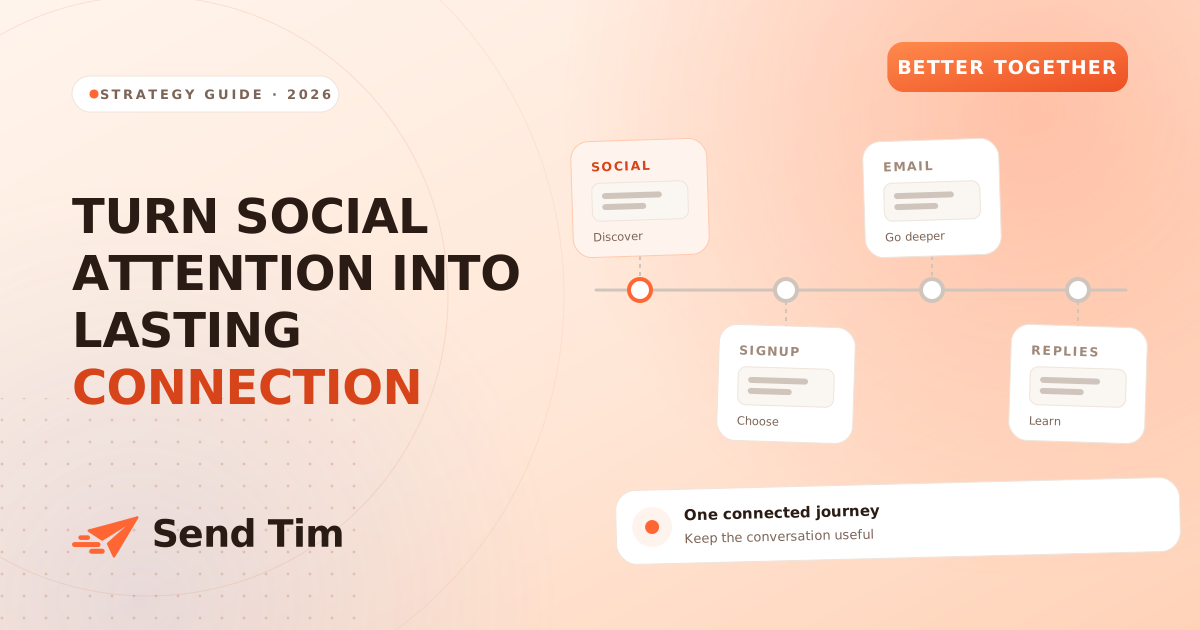
Now imagine the same video ends with an invitation to get a five-minute espresso troubleshooting guide. The signup page explains what arrives next. The first email delivers the guide; the next helps readers adjust their grind; a later message answers a question from the video comments. Social and email now form one useful journey. This is a hypothetical example, but it illustrates a practical strategy any small team can adapt.
Give social media and email different jobs
Social content can introduce an idea to someone who has never heard of your business. Public conversations also reveal the language people use to describe their problems. Email gives subscribers a more deliberate place to receive a lesson, revisit an offer, or reply with context. Neither channel guarantees attention. Together, they give interested people more than one way to engage.
| Job | Social media contribution | Email contribution |
|---|---|---|
| Discovery | Introduce a useful idea in a public post | Give existing readers something worth sharing |
| Learning | Surface questions through comments and conversations | Explain a topic with context, examples, and follow-up |
| Decision | Demonstrate a product or answer a visible objection | Help an interested subscriber choose a relevant next step |
| Feedback | Reveal recurring questions from a wider audience | Invite detailed replies from people who opted in |
An email list is a more portable contact relationship than a follower count, but it still depends on permission, deliverability, and reader interest. Treat subscribing as a choice to receive something useful. A follow, a comment, or a public email address is not an invitation to add someone to a newsletter.
Build the handoff before publishing more posts
Choose one recurring audience problem and one resource that helps solve it. The resource can be a checklist, short lesson, worksheet, or regular newsletter. It does not need to be large. A narrow promise makes the transition easier to explain: “Get the espresso troubleshooting checklist” tells a reader more than “Join our community.”
- Start with the post. Help with a recognizable problem before asking people to leave the platform.
- Make the invitation specific. Say what the subscriber receives and why it extends the post.
- Match the landing page. Repeat the same offer, show a preview, and explain any ongoing emails.
- Keep the form focused. Ask for the information needed for the promised experience.
- Deliver immediately. Use the first email to fulfil the promise and explain what comes next.
Place the invitation wherever your audience already looks for a next step: a profile link, a relevant pinned post, or the closing line of an educational post. Available placements differ between platforms, so check the current options in the channel you use. Keep the destination consistent long enough to learn whether the promise resonates. Our email lead generation guide explores how to build a focused signup journey.
Continue the context in your welcome emails
A subscriber arriving from a beginner tutorial should not have to decode a general company introduction before getting help. Keep the first messages close to the topic that prompted the signup. When useful, record an acquisition source or chosen interest so the follow-up can reflect that context. A source describes where someone arrived from; a stated preference tells you more about what they want.
| Message | Reader value | Primary next step |
|---|---|---|
| First email | Deliver the troubleshooting guide and set expectations | Use the checklist |
| Second email | Explain one adjustment with a worked example | Try the adjustment |
| Third email | Answer a common question and suggest a relevant resource | Reply with the remaining problem |
Choose spacing that fits the promise and the time a reader needs to act. Coordinate these messages with regular campaigns so a new subscriber is not overwhelmed. If people request different topics, use a small set of email segments rather than assuming every follower wants the same content. Review the actual sequence by subscribing with a fresh address on your phone.
Turn one useful idea into a two-way content loop
Repurposing works when the idea remains recognizable and each version earns its place. A social post might show a single before-and-after example. The email can explain the method, include a checklist, and discuss when the method will not help. A later post can answer a new question raised by readers. Copying an entire newsletter into a caption usually misses the opportunity to adapt the lesson to the setting.
- Listen publicly: collect recurring questions from comments and conversations.
- Teach in email: select one question and answer it with enough detail to be useful.
- Invite a reply: ask a specific question, such as “Which step was hardest to apply?”
- Bring the lesson back: turn a recurring obstacle into another useful public post.
- Protect reader trust: get permission before publishing an identifiable reply, quote, or customer example.
Email can also send readers toward a worthwhile social conversation. Link to a live demonstration, a discussion where readers can contribute, or an example that benefits from video. Explain the reason to click. A row of social icons gives access to your accounts; a specific invitation gives readers a reason to visit. The newsletter strategy guide can help define a repeatable editorial promise.
Measure the journey across both channels
Before launching, choose one downstream action that represents progress: completing a lesson, requesting a demo, trying a workflow, or placing an order. Then track the steps leading to it. A large audience is useful only if the content attracts people whose needs match what you offer. Compare acquisition sources over the same observation period so a newer group does not look weaker simply because it has had less time.
Use consistent campaign parameters on links into your website. For example, a profile link might use utm_source=instagram, utm_medium=organic_social, and utm_campaign=espresso_guide. Newsletter links can use their own source and the email medium while retaining the campaign name. Google’s campaign URL guidance explains these parameters. Website attribution and signup-source storage need to be configured; adding a UTM parameter does not automatically create a contact field.
| Question | Metric | What to investigate |
|---|---|---|
| Does the invitation attract visits? | Campaign-tagged landing-page sessions | Post relevance, invitation clarity, and link placement |
| Does the offer earn signups? | Completed signups / landing-page sessions | Promise, page clarity, form friction, and traffic quality |
| Does the follow-up help? | Subscribers taking the chosen action within a fixed window | Message relevance, destination quality, and timing |
| Does the experience match expectations? | Replies, unsubscribes, and complaints | Offer mismatch, excessive frequency, and unclear expectations |
Treat attribution as a partial view. People may see several posts, change devices, or return directly before subscribing. Do not add conversion totals from separate platforms and assume every event represents a different person. Opens also need context: Apple’s Mail Privacy Protection can prevent senders from knowing whether a message was opened. Use meaningful actions and reader feedback alongside the email metrics in your reports.
Connect the channels with a 30-day plan
Start with a manageable experiment. One channel and one offer make it easier to understand where the journey breaks. The following schedule is a starting point for a small team, not a performance guarantee. If traffic is limited, extend the observation period before deciding that a change worked.
- Days 1–7: choose the problem. Review audience questions, select one topic, and create a useful resource or sample newsletter. Define the downstream action and the promise on the signup page.
- Days 8–14: build and test. Create the form and welcome messages. Check the full path from social link to delivered email, including mobile reading, destinations, and unsubscribe behavior.
- Days 15–21: publish and listen. Share several useful treatments of the same problem. Keep the offer consistent, answer comments, and note where visitors or subscribers seem confused.
- Days 22–30: review one bottleneck. Examine visits, signups, follow-up actions, and feedback. Change one meaningful part of the journey and record what you expect it to improve.
Avoid the gaps that make the channels feel disconnected
The most common gap is a broken promise: a helpful social lesson leads to a generic signup form, followed by an unrelated promotion. Another is treating every interaction as a sales signal. Someone who saves a tutorial may simply want to learn. Give them a relevant choice, then let their preferences and actions shape the next step.
- Too many destinations: choose one main invitation for each post instead of asking for a follow, signup, share, and purchase at once.
- An incentive without a relationship: explain the ongoing newsletter before people subscribe, then make the follow-up useful beyond the free resource.
- Identical content everywhere: adapt the depth and format while keeping the underlying promise consistent.
- A growing list with little interest: review the offer and acquisition source before spending more effort sending to the same audience.
The practical goal is a recognizable continuation. Someone discovers a useful idea, chooses to hear more, receives what was promised, and helps you understand what to explain next. Build that connection once, learn from the people who use it, and carry those lessons into your next campaign.
Frequently asked questions
How do email marketing and social media work together?
Social posts introduce useful ideas and invite interested people to subscribe. Email continues the same topic with more depth and relevant follow-up. Subscriber questions can then inform future public content, creating a feedback loop between the channels.
How can I turn social media followers into email subscribers?
Offer a specific resource or recurring newsletter related to the content they already enjoy. Link to a focused signup page, explain what they will receive, and deliver the promise in the first email. Let people choose to subscribe.
Should I share the same content in email and on social media?
Reuse the core idea but adapt the treatment. A social post can show one example, while an email explains the method and provides a practical next step. Give readers a clear reason to engage with each version.
Which metrics show whether a combined strategy is working?
Review tagged website visits, signup conversion, and a meaningful action within a consistent observation period. Read replies and monitor unsubscribes and complaints. Attribution is incomplete, so use several signals rather than relying only on follower counts or email opens.