On this page
- 1. Choose one primary business goal
- 2. Define the audience and the promise
- 3. Build a permission-based list
- 4. Map the subscriber journey
- 5. Choose campaigns and automations by job
- 6. Segment only when the message should change
- 7. Plan content and cadence together
- 8. Protect deliverability before scaling
- 9. Build a measurement scorecard
- 10. Improve one bottleneck at a time
- A practical 90-day email marketing plan
An email marketing strategy is a plan for who you email, why you email them, what value each message provides, when it arrives, and how you decide whether it worked. It is broader than a content calendar and more specific than “send a newsletter every week.” A useful strategy makes every send accountable to a customer need and a business outcome.
The framework below is designed for a small team. You can complete a first version in a day, launch the essential pieces over 90 days, and improve it with real subscriber behaviour. The goal is not to design every future email. It is to build a system that helps you choose the right email next.
1. Choose one primary business goal
Start with the business change email should support during the next quarter. “Increase engagement” is too vague. A useful goal names an audience, an action, and a time window: convert more trial users into active customers, increase second purchases within 60 days, or reduce the number of new subscribers who disappear after signup.
| Business goal | Email job | Primary evidence |
|---|---|---|
| Acquire qualified leads | Make the value exchange clear and welcome new subscribers | Confirmed signups and first useful action |
| Activate new customers | Guide the shortest path to value | Activation or onboarding completion |
| Increase repeat purchase | Time useful follow-up to the product lifecycle | Second purchase within a defined window |
| Retain the right audience | Deliver recurring value and manage inactivity | Active subscribers, churn, complaints, and retention |
Choose one primary outcome and a small set of supporting signals. If the quarter has five equal priorities, campaign decisions become political instead of strategic. You can still send operational messages and maintain existing programmes; the primary goal simply determines where improvement work goes first.
2. Define the audience and the promise
Describe the person, their current situation, and the problem your emails help them solve. “All contacts” is a database field, not an audience. “Independent store owners who want one practical promotion idea each week” is specific enough to guide acquisition, content, and cadence.
- Who are they? Use a role, lifecycle stage, purchase state, or expressed interest you can identify reliably.
- What do they need now? Name the question or decision that makes the email timely.
- What will they receive? State the topic, value, and realistic frequency in plain language.
- Why should they trust you? Match the first emails to the promise made at signup or purchase.
Write the promise as one sentence: “We help [audience] achieve [outcome] with [type of email] every [cadence or trigger].” This becomes a filter for content ideas and a source of copy for the signup form. If a newsletter is central to the plan, use the email newsletter strategy guide to turn that promise into a repeatable editorial system.
3. Build a permission-based list
List growth is valuable only when the new contacts expect and want the messages. Use signup forms, checkout choices, lead magnets, product registration, or event registration where the email purpose is clear. Record the source, time, and version of the promise accepted. Never buy a list or silently turn an operational address into a marketing subscriber.
The email lead generation guide explains how to choose a relevant value exchange, place forms, and measure form quality. If you market to people in the EU, review the GDPR email marketing checklist and get legal advice for your specific processing and markets.
4. Map the subscriber journey
List the moments where an email can remove uncertainty or help the person take a useful next step. Typical moments include signup, evaluation, purchase, onboarding, first value, repeat need, and inactivity. The journey should describe customer progress, not your internal campaign calendar.
| Moment | Subscriber question | Useful email response |
|---|---|---|
| Signup | Did it work, and what happens next? | Deliver the promise and set expectations |
| Evaluation | Is this relevant to my situation? | Teach, answer objections, and show evidence |
| Purchase or activation | How do I get value now? | Confirm, guide, and remove friction |
| Ongoing relationship | Why should I keep paying attention? | Provide relevant education, updates, or offers |
| Inactivity | Do I still want these emails? | Ask, adapt frequency, or stop sending |
Mark the biggest gap between two stages. That is usually a better first project than adding another general campaign. The email funnel guide shows how to define each handoff and find where subscribers stop progressing.
5. Choose campaigns and automations by job
Use a campaign when the timing or content is shared: a newsletter, product announcement, event, seasonal promotion, or one-time update. Use an automation when a reliable event should start a repeatable response: signup, trial start, purchase, delivery, renewal, or sustained inactivity.
- Welcome sequence: deliver the signup promise and guide one first action. See the welcome email sequence.
- Onboarding or post-purchase sequence: help the customer receive value before asking for more. See the post-purchase email guide.
- Recurring campaign: answer one audience question or support a timely business moment.
- Re-engagement sequence: ask inactive subscribers whether the relationship should continue, then honour the answer. See the re-engagement campaign guide.
Every automation needs a trigger, a purpose, timing rules, exclusions, an exit, and an owner. Start with the flows tied closest to the primary goal. The complete email marketing automation guide includes seven practical workflows and the stop rules each one needs.
6. Segment only when the message should change
Segmentation is useful when two groups need meaningfully different content, timing, or treatment. Good starting signals include lifecycle stage, explicit topic preference, purchase state, and recent meaningful behaviour. Avoid dozens of tiny segments that nobody can maintain or explain.
For each segment, write the decision it changes: “Customers who bought product A receive setup guidance for A,” or “Subscribers who selected weekly updates do not receive the daily digest.” The email segmentation guide covers stable rules and exclusions, while the personalization guide explains which data creates relevance without crossing into surprising inference.
7. Plan content and cadence together
Choose a frequency the audience can understand and the team can sustain during a normal month. More email is not automatically more strategy. Each message should have one primary job, one recognizable sender, and one clear next step. A campaign may contain supporting links, but the main action should not be a puzzle.
- Subject line: make a specific promise that the email keeps. Use the subject line guide for practical patterns and testing advice.
- Opening: tell the reader why the message matters now.
- Body: provide the information needed to make the next decision.
- Call to action: describe what happens after the click.
- Design: keep the hierarchy readable on mobile, in dark mode, and with images blocked. See the email design guide.
Use a send calendar to see the whole subscriber experience. A person may qualify for a newsletter, a promotion, and several automations in the same week. Frequency controls and suppression rules should prevent your internal teams from competing for the same inbox.
8. Protect deliverability before scaling
Email cannot create value if it does not reach the inbox. Authenticate the sending domain with SPF, DKIM, and DMARC; use a monitored reply address; process bounces and complaints; make unsubscribing easy; and stop regular sends to persistently inactive contacts. Increase volume gradually when the domain or programme is new.
Deliverability is not a last-minute technical check. Acquisition quality, cadence, relevance, and list hygiene all shape sender reputation. Use the email deliverability guide to diagnose authentication, reputation, and content problems in the right order.
9. Build a measurement scorecard
Measure the outcome that matches the email job, then use engagement and risk metrics as context. A welcome email might be judged by successful delivery and first action; a newsletter by qualified clicks, replies, and downstream behaviour; a post-purchase flow by onboarding progress, support demand, and repeat purchase.
| Layer | What to measure | Question answered |
|---|---|---|
| Delivery | Delivered, hard bounces, soft bounces | Could the message reach the audience? |
| Attention | Qualified clicks, replies, site behaviour | Did the message earn useful attention? |
| Outcome | Activation, purchase, booking, retention | Did the intended change happen? |
| Trust | Unsubscribes, complaints, negative replies | What did the message cost the relationship? |
Open rates are useful for broad trend checks but are affected by privacy protections and automated activity. Clicks can also be generated by security scanners. Avoid making individual subscriber decisions from one noisy event. The email marketing metrics guide explains how to read the numbers together.
10. Improve one bottleneck at a time
Review the scorecard on a fixed schedule and choose the most important constraint. If delivery is weak, fix list quality or authentication before rewriting the call to action. If delivery is healthy but qualified clicks are low, revisit the audience, promise, and message. If clicks are strong but the outcome is weak, inspect the destination and offer before sending more frequently.
Write a hypothesis before changing the programme: “New subscribers may not understand the first step, so we will replace three equal links with one guided action and compare activation over 14 days.” Change one major variable when possible and keep the evaluation window consistent. Use the email A/B testing guide when a controlled comparison is worthwhile.
A practical 90-day email marketing plan
- Days 1–30 — foundation: choose the goal, define the audience promise, audit consent and data, authenticate the domain, map the journey, and record baseline metrics.
- Days 31–60 — essential programme: improve the signup path, launch or repair the welcome sequence, establish one sustainable recurring campaign, and add exclusions and frequency controls.
- Days 61–90 — learning loop: build the scorecard, review the main bottleneck, run one focused improvement, document the result, and choose the next constraint.
At the end of 90 days, you should have a strategy you can explain in a page: the goal, audience, promise, lifecycle map, active campaigns and automations, operating rules, scorecard, and next experiment. That document is more valuable than a dense calendar because it explains why the calendar exists.
Frequently asked questions
What is an email marketing strategy?
An email marketing strategy is a plan that connects a business goal to a defined audience, a clear subscriber promise, the right campaigns and automations, operating rules, and a measurement process. It explains who should receive each email, why it should be sent, and how success will be evaluated.
How do you create an email marketing strategy?
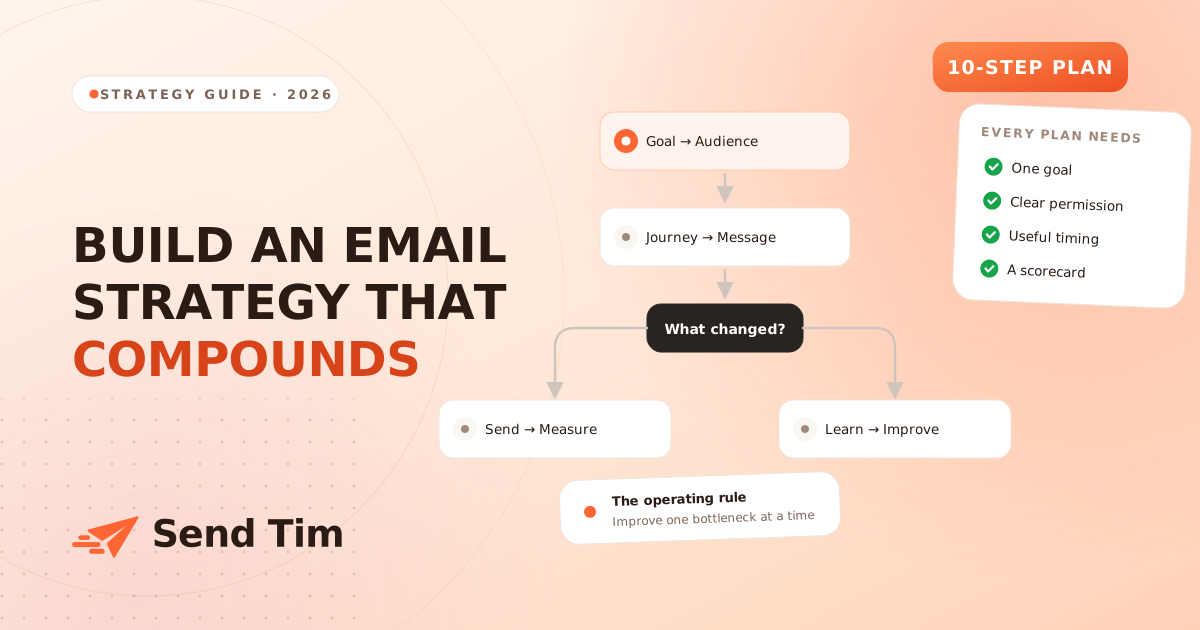
Choose one primary business goal, define the audience and promise, build a permission-based list, map the subscriber journey, select the essential campaigns and automations, set segmentation and frequency rules, protect deliverability, create a scorecard, and improve one bottleneck at a time.
What are the most important parts of an email marketing plan?
The essential parts are the business goal, audience, value promise, acquisition and consent rules, lifecycle map, campaign and automation plan, content cadence, deliverability controls, success metrics, ownership, and a regular review process.
How often should a business send marketing emails?
Send at a frequency the audience expects and the team can sustain with useful content. Weekly, fortnightly, or monthly can all work. Account for automated emails and promotions in the same frequency plan, and watch unsubscribes and complaints after material changes.
Which email marketing metrics should I track?
Track delivery and bounces, qualified clicks or replies, the business outcome tied to the email job, and trust signals such as unsubscribes and complaints. Interpret them together; no single metric can describe the health of the programme.