On this page
- What an email funnel is, and three things it is not
- The four stages, and the single job of each
- Give every stage an exit condition
- Measure the handoffs, not the totals
- What belongs at each stage
- How long should an email funnel be?
- Five ways funnels quietly fail
- Building it without it becoming unmaintainable
Nearly every team that sells anything has drawn a funnel on a whiteboard. Far fewer can say what percentage of people move from the second stage to the third, which is the only part of the drawing that tells you what to do next. The diagram is easy; the measurement is the work.
This guide is about the measurement. What each stage is actually for, when a contact should leave it, which number to watch between any two stages, and how to tell a funnel that needs another email from one that needs a different email. If you are building the individual sequences, Lead Nurturing Emails and Email Marketing Automation go deeper on each one; this is the layer above them.
What an email funnel is, and three things it is not
An email funnel is the path a person takes from first giving you their address to becoming a customer, described as a small number of stages with a measurable step between each pair. It is a model you use to decide what to send and to find out what is not working.
Three common confusions are worth clearing up, because each one leads to a different mistake:
- It is not one automation. An automation is a mechanism, and a funnel usually needs several of them plus some broadcast campaigns. Teams who equate the two end up building one enormous sequence that nobody can safely edit.
- It is not a sales ladder. The stages are not degrees of pushiness. A nurture email that explains one hard thing well does more for the funnel than an email that asks for the sale slightly harder than the last.
- It is not a straight line. People skip stages, re-enter them, and buy from the first email. The funnel is a way to organise your sending, not a claim about how any individual behaves.
The four stages, and the single job of each
Four stages is enough for almost everyone. The discipline is not in having more of them; it is in each one having a single job and a condition that moves the person on.
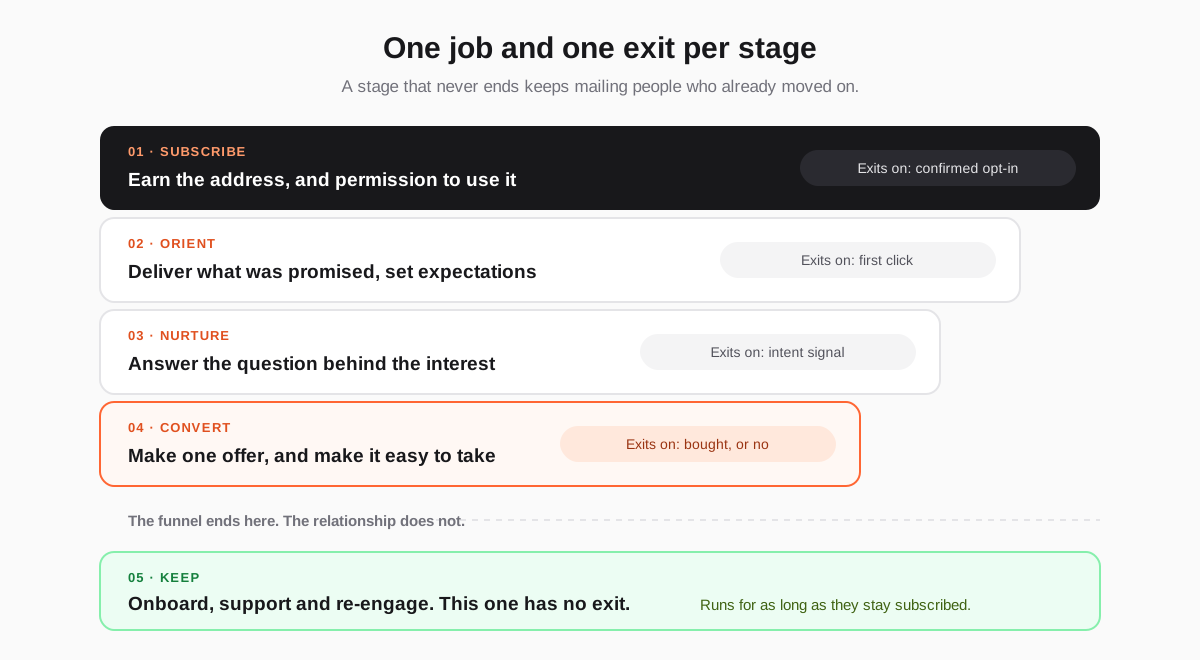
| Stage | Its one job | Exits when |
|---|---|---|
| 1. Subscribe | Earn the address and the permission to use it, in exchange for something specific. | The opt-in is confirmed and the promised thing has been delivered. |
| 2. Orient | Prove the promise was real, say what you will send and how often, and get the first deliberate click. | They click something, or the series finishes. |
| 3. Nurture | Answer the question behind their interest. One idea per email, chosen from what they clicked. | They show an intent signal: pricing, a demo, a reply, a repeat visit. |
| 4. Convert | Make one offer, remove the obvious objection, and make the next step a single click. | They buy, or they clearly do not. Both are exits. |
Notice what is missing: a stage for "send the monthly newsletter". Broadcasts run alongside the funnel and are not part of it. Mixing them in is how teams end up unable to tell whether the nurture stage works, because half the clicks it gets came from an unrelated campaign.
Give every stage an exit condition
This is the part most funnels are missing, and it causes more damage than any other single mistake. If the nurture stage has no exit, a person who booked a demo on Tuesday still receives the "have you considered trying us?" email on Thursday. You look unaware, which is worse than being quiet.
Every stage needs three things written down before you build it:
- The entry condition. What puts someone into this stage. Usually the exit of the stage before it.
- The exit condition. What takes them out, including the negative case. "Clicked pricing" and "finished all five emails without clicking" are both exits.
- The maximum stay. The longest anyone sits here before being moved on regardless. Without this, people accumulate in stages you forgot about.
Measure the handoffs, not the totals
End-to-end conversion is a reporting number. It tells a founder how the quarter went and tells you nothing about what to change. Stage-to-stage conversion is a working number: it names the email that is costing you.
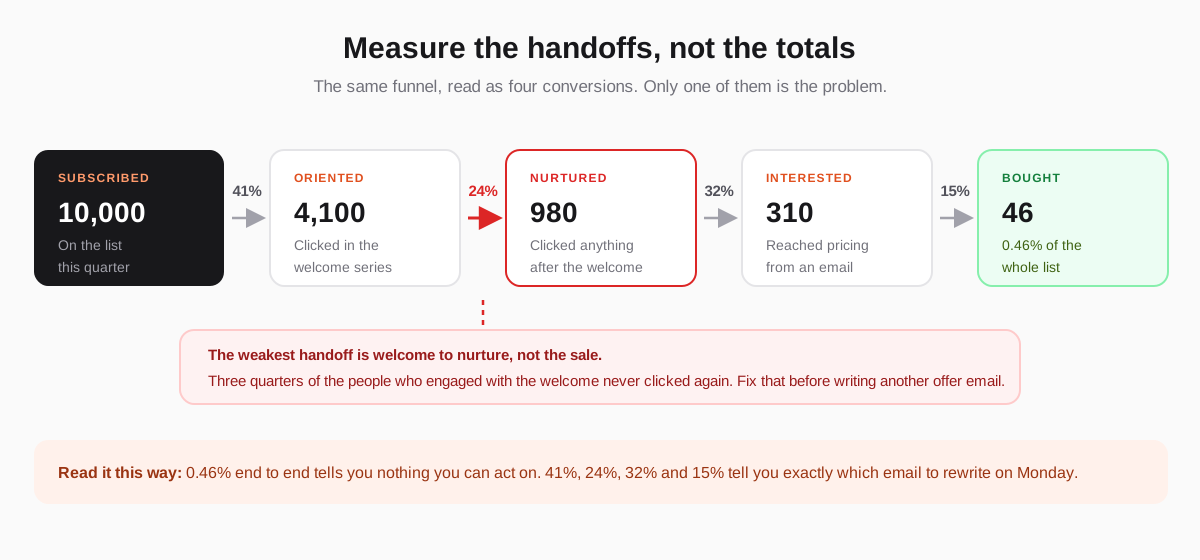
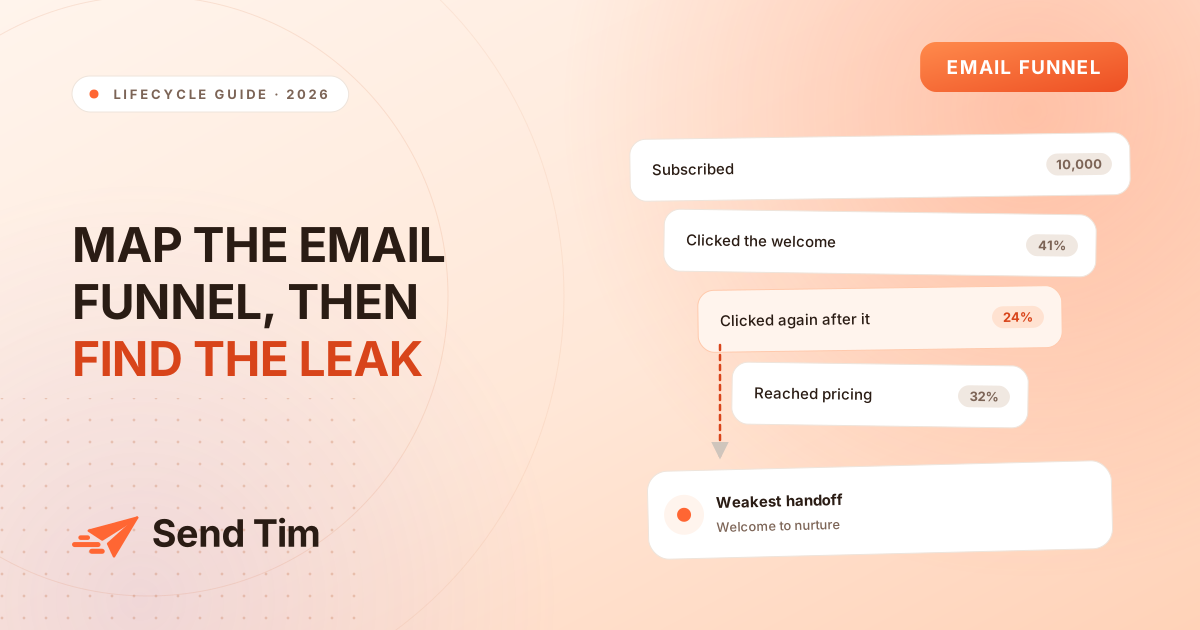
In the example above, the instinct is to blame the final step: only 15% of people who reached pricing bought. But that step is converting a warm, self-selected group, and 15% of them is respectable. The real loss is earlier. Of the 4,100 people who clicked something in the welcome series, 3,120 never clicked again. That is the largest group of interested people in the whole picture, and nothing in the funnel is currently aimed at them.
The fix follows from the number. Rewriting the offer email would improve the smallest step in the chain. Rewriting the first two nurture emails, or segmenting them by what each person clicked in the welcome, addresses the step where thousands of people are being lost. Use clicks for every one of these measurements, not opens: privacy proxies make open rate unusable for anything that branches.
| Weak handoff | Most likely cause | What to change |
|---|---|---|
| Subscribe → Orient | The signup promised one thing and the first email delivered another, or it arrived too late. | Send the promised thing immediately, in the first line, before anything else. |
| Orient → Nurture | The nurture emails are generic, so they do not follow on from whatever caused the first click. | Branch the nurture stage on what they clicked. One topic per path. |
| Nurture → Convert | There is no intent signal, so nobody qualifies, or the signal is set too strictly. | Add a low-friction way to raise a hand: a comparison page, a demo link, a reply prompt. |
| Convert → Bought | The offer is unclear, or the objection stopping them is never addressed. | One offer per email, one button, and name the objection directly. |
What belongs at each stage
The content question gets easier once each stage has a job. You are not asking "what should email four say?", you are asking "what does this stage need to accomplish, and what is the shortest email that does it?"
Subscribe
A confirmation and the thing you promised. Nothing else. This is not the place for a product tour. If you use double opt-in, the confirmation email has exactly one job and should contain exactly one link. Signup form tactics covers what gets people here in the first place.
Orient
Two or three emails over a week. Who you are, what you will send and how often, and one genuinely useful thing that stands alone. End each with a question or a link worth clicking, because the click is the exit condition and you need it to happen.
Nurture
One idea per email, chosen by what they clicked. Someone who read about deliverability gets the follow-up on authentication; someone who read about segmentation gets the one on behavioural rules. This is where a generic funnel bleeds people and a segmented one does not.
Convert
Two emails, not six. The first makes the offer and names the single most common objection. The second, a few days later, is shorter and gives one piece of proof: a customer who had the same problem, a number, a guarantee. Then stop and return them to the nurture stage or the newsletter.
How long should an email funnel be?
As long as the decision takes, which is a property of what you sell rather than of email. The useful question is how long a buyer typically deliberates, and whether anyone else has to approve the purchase.
- Low price, individual decision (a £30 product, a course): four to six emails over two weeks. Longer and you are padding.
- Mid price, considered purchase (most SaaS): eight to twelve emails over four to six weeks, with the nurture stage branching by interest.
- High price, multiple approvers: the funnel stops being a schedule and becomes a library. Send less often, aim each email at a different person in the room, and expect the sale to happen in a meeting you are not in.
When in doubt, build the shortest version that covers the four stages, measure the handoffs for a month, and add emails only where the numbers show people leaving. Funnels grow fine; they almost never shrink once someone has written the emails.
Five ways funnels quietly fail
- Stages with no exit. The single most common fault. People accumulate, receive irrelevant mail, and unsubscribe at the worst possible moment.
- Escalating urgency instead of escalating relevance. Each email asks harder rather than explaining better. This trains people to ignore you before they ever reach the offer.
- Measuring the whole funnel as one number. It moves slowly, hides the cause, and gives you nothing to act on this week.
- No path for the people who said no. A clear no is valuable. Send them back to the newsletter rather than deleting them or, worse, restarting the sequence.
- Running the funnel on a list that should have been cleaned. Unengaged contacts drag deliverability down for everyone, so the funnel converts worse than its content deserves. Re-engagement belongs before the funnel, not after it.
Building it without it becoming unmaintainable
Build one stage at a time, and let it run long enough to produce a number before you build the next. A funnel assembled in a single afternoon is a funnel nobody has evidence for, and the stage you got wrong will be buried under three more that depend on it.
Keep each stage as its own automation rather than one long flow. Separate automations can be paused, edited and measured independently, and a mistake in the nurture stage does not require touching the welcome series that is working.
Next, go a layer deeper on whichever stage your numbers point at: the welcome series for orient, segmentation for nurture, and metrics for deciding which of these numbers you can trust.
Frequently asked questions
What is an email funnel?
An email funnel is the path a subscriber takes from giving you their address to becoming a customer, broken into a few stages with a measurable step between each one. In practice it is several automations and campaigns working together, with rules that move people between stages based on what they do.
How many emails should an email funnel have?
It depends on how long the buying decision takes. A low-priced individual purchase usually needs four to six emails over two weeks; a considered SaaS purchase needs eight to twelve over a month or more. Build the shortest version that covers all four stages, then add emails only where the numbers show people dropping out.
What is a good email funnel conversion rate?
The end-to-end figure varies so much by price and audience that benchmarks are close to useless. Compare each handoff against your own previous months instead. A healthy funnel shows roughly consistent conversion between stages, with no single step losing three quarters of the people who reached it.
What is the difference between an email funnel and an email sequence?
A sequence is one automation: a fixed series of emails triggered by one event. A funnel is the map over all of them, including the broadcast campaigns, the segments that move people between sequences, and the exits. One funnel usually contains several sequences.
Where do most email funnels leak?
Usually between the welcome series and the nurture stage. People engage with the welcome because it delivers something they asked for, then receive generic nurture emails that do not follow on from what caught their interest. Branching the nurture stage on what each person clicked recovers more of them than any change to the final offer email.